
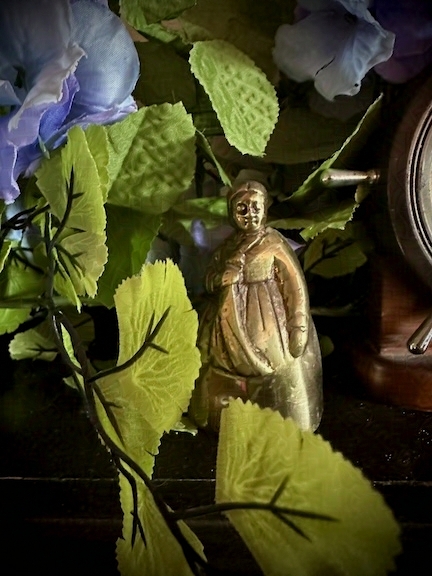
We understand. Some among you practice alone and in secret by choice or by circumstance, or perhaps for your safety. These occasional posts are for you..
You may look with envy at carefully curated altars that you see in books or on social media. You know the ones. The altar cloths with magical symbols stitched in glittering threads, the skull-shaped candle holders, the small cast iron cauldron, the cut glass goblet, tarot cards, crystals, candles, incense, and all the trimmings. And you may think, “I can’t be a real witch without all that.”
We say hogwash. Humbug. Balderdash. And all the modern equivalents thereof.
You are real, as real as any practitioner. Our predecessors worked with what they had and under whatever circumstances they found themselves in, and so may you. So let us consider the possibilities.
Do you need an altar?
Of course, “need” and “want” are entirely separate things. You don’t absolutely need a specific surface with your tools laid out, ready for use, and looking quite obviously like a witchy altar. It is lovely to have a dedicated space that you can go to when you do your work, where just entering the space puts you in the mindset that you want.
But as you well know, we don’t all have that luxury. In such cases, it can help to redefine your idea of an altar.
Throughout history, altars have been places of devotion to deities, such as one might find in a temple, and provided a surface for carrying out rituals. For today’s witches and magical practitioners, an altar is a working space, a place to lay out the physical materials for rituals and spellwork, and where actions in that work may be performed. It might include images or figures of deities one is working with, if one works with deities, It might include aids to meditation or energy work.
Or… it might consist of any materials you need laid out on any convenient surface when you have time alone to work, then put away when you are done. There are no absolute rules. It’s your practice.
But when you want something longer-lasting and less clandestine, you have to be creative.
Ho, ho, ho, Merry… Witchmas?
Christmas, New Year’s, Valentine’s Day, Lunar New Year, Easter… all through the year, ’tis the season to decorate for various holidays. Take advantage of it.
The Wiccan Wheel of the Year is a relatively modern invention (as is Wicca), one that divides the year neatly into equal divisions of time. Conveniently, most of the Wiccan holidays occur fairly close to other holidays celebrated in the Western world, and include some of the same trappings.
For example, consider Christmas and Yule. Both happen on or near the Winter Solstice. Both include holly, greenery, shiny decorations, gift-giving, feasting, candles, and more. While decorating for Christmas, you could lay out a Yule-themed altar in plain view on a fireplace mantle or any horizontal surface. Use natural materials or good-quality greenery garland from the craft store. Add sprigs of holly and mistletoe, both protective symbols. Tall candles in candle holders add a nice vertical touch, as well as color that you want to include — gold and green for prosperity, perhaps. Electric candles work as well. Perhaps pine cones, or decorative woodland animals. Slice oranges cross-wise and dry the slices for symbols of the returning sun, as well as, “Oh, these were popular in Victorian times, aren’t they pretty?”
Continuing to decorate for the seasons all year allows for more opportunities to create seasonal altars. It doesn’t have to be elaborate or obvious. Some pretty craft store floral garland draped across a mantel or top of a book case is simple, impactful, and a good foundation for a few smaller ornaments that reflect both the season and your intentions.
“This garden needs some whimsy.”
If you have an outdoor place you can call your own, be it a yard, a garden, even a porch or a tiny deck of an apartment, consider creating a decorated space that can serve as an occasional place for your practice.
Fairy gardens are whimsical tiny gardens that might include dwarf plants, figurines, handmade “fairy houses” or “fairy doors,” small wind chimes, tiny lights, crystals, tiny water features — and now clever you is thinking, “Crystals? Hmm, figurines could represent deities… chimes for air elements…” Yes, that adorable fairy garden can be an altar to nature spirits in plain sight. You’ll find plenty of ideas in books and on websites about fairy gardens, including ways to craft the furnishings from found materials and natural materials.
Delightfully nerdy options
We worked in a setting with many people as nerdy as ourselves, where it was fairly standard practice to adorn one’s desk and office space with posters, figurines, stuffies, decorated mugs, and the like, proudly displaying the nerderies of our choice. In any setting where it’s normal to arrange whimsical items on a desk, bookshelf, or tacked to a corkboard, consider arranging a discrete little altar. Pentagrams might be a little too obvious, but a collection of crystals will probably be perceived as just a collection of crystals. Bonus if you’re allowed to have a small setup for brewing tea at your desk. With tea and herbs and some hot water, you can have a cauldron in a cup, and a meditative ritual that just looks like a tea break.
Trust yourself
You understand your circumstances. You know the limitations and constraints of where you live and where you work. Given your situation, you can use your wits and imagination to create arrangements of items to serve as a temporary or long-term altar while appearing to be something merely decorative. Remember, you don’t have to include the fancy items from a metaphysical shop that a witch on social media claims are essential. Magical practice isn’t about having exactly the right props. Use what you have, and remember, the power is in you.


You must be logged in to post a comment.